
Japan to Triple Departure Tax from July 2026: What Travellers Must Know
Japan is one of the most loved international travel destinations for Indian travellers. From cherry blossoms and ancient temples to futuristic cities and world-class transport, Japan offers a unique experience. However, travelling to Japan is set to become more expensive starting July 2026. The Japanese government has announced that it will triple its departure tax, affecting all travellers leaving Japan by air or sea, including tourists, business travellers, and Japanese citizens. Along with this, Japan is also planning new travel-related fees, which will further increase the overall cost of visiting the country in the coming years.
In this blog, Trade Wings Limited explains everything in the simplest way possible—what is changing, how much extra you’ll pay, and how to plan smartly.
What Is Japan’s Departure Tax?
Japan currently charges a departure tax of ¥1,000 per person when travellers leave the country. This tax is officially called the International Tourist Tax.
From July 2026:
- The tax will increase from ¥1,000 to ¥3,000 per person
- It applies to everyone aged 2 years and above
- It applies to all nationalities, including Japanese citizens
- It is charged when leaving Japan by air or sea
This means if you are flying out of Japan after July 2026, you will automatically pay this higher tax as part of your ticket.
Why Is Japan Increasing the Departure Tax?
Japan has seen a massive rise in tourism in recent years. While this is good for the economy, it has also created serious challenges.
The main reasons for the tax increase are:
1. Over-tourism at Popular Places
Cities like Tokyo, Kyoto, Osaka, and Mount Fuji areas are facing heavy crowding, especially during peak seasons.
2. Congestion and Infrastructure Pressure
Public transport, streets, airports, and tourist facilities are under pressure due to high visitor numbers.
3. Behavioural Issues
Local authorities have reported issues related to littering, noise, and disrespectful behaviour at heritage sites.
4. Funding Tourism Management
The government plans to use the extra tax revenue to:
- Improve tourist infrastructure
- Control crowds at major attractions
- Enhance visitor safety and experience
- Promote sustainable tourism
How Much Revenue Will Japan Generate?
According to government estimates:
- Tourism-related tax revenue for FY 2026–27 (April 2026 to March 2027) is expected to rise nearly 2.7 times
- Total revenue is projected to reach around ¥130 billion
- This shows how serious Japan is about managing tourism responsibly.
Will Indian Travellers Be Affected?
Yes. Indian travellers will be directly impacted by this change.
If you are:
- Visiting Japan for tourism
- Travelling for business
- Studying or attending events
- Going on cruises that depart from Japan
You will pay the ¥3,000 departure tax when leaving the country.
While this may not seem very high individually, it adds up for:
- Families
- Group tours
- Corporate travel budgets
Additional Travel Fees Planned by Japan
The departure tax is not the only upcoming cost. Japan is planning more travel-related fees in the coming years.
JESTA: Japan Electronic System for Travel Authorisation
By 2028, Japan plans to introduce JESTA, a pre-screening system for travellers from visa-free countries.
Key Details:
- Similar to ESTA (USA) or ETIAS (Europe)
- Mandatory pre-travel authorisation
- Expected fee: ¥2,000 to ¥3,000 per person
- Required before travelling to Japan
Although India is currently not visa-free for Japan, policy changes in the future could bring Indian travellers under this system as well.
Combined Travel Cost Impact
If all planned fees are introduced as expected:
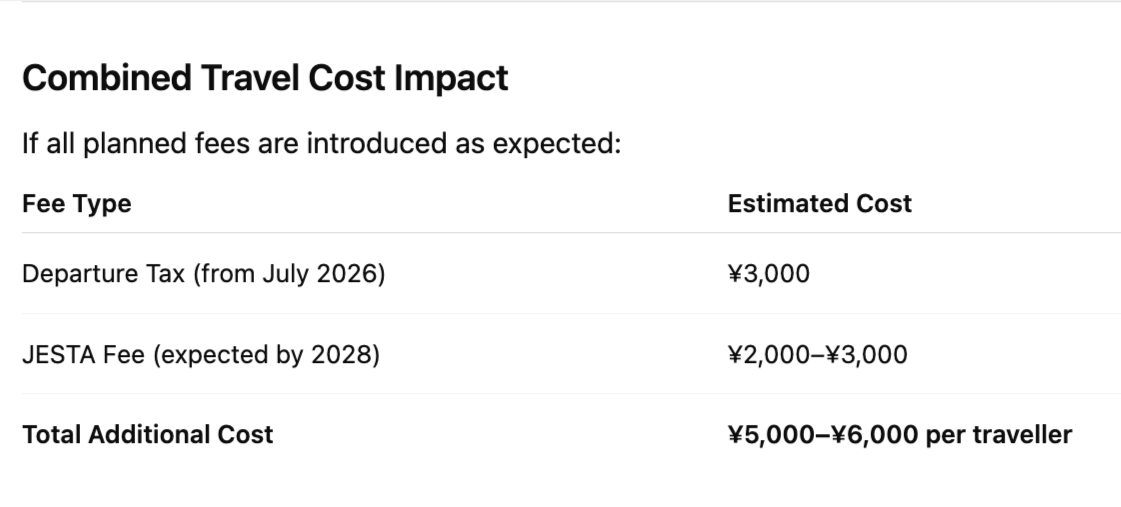
This is over 5 times higher than what travellers pay today.
Does This Affect Japanese Citizens?
Yes. Japanese citizens will also pay the increased departure tax when leaving the country. This shows that the policy is not targeting foreigners alone but is part of a broader tourism management strategy.
What This Means for Travel Planning
With higher taxes and new systems coming in, travellers need to plan more carefully.
Tips from Trade Wings Limited:
- Book Early
Flight and travel costs may rise as airlines adjust pricing. - Plan Travel Before July 2026
If possible, travelling before the tax hike can help you save. - Budget Accurately
Include departure taxes and future authorisation fees in your travel budget. - Stay Updated on Rules
Travel policies are changing fast. Stay informed to avoid last-minute issues. - Use Expert Travel Assistance
Professional travel management helps you avoid surprises.
How Trade Wings Limited Helps You Travel Smarter
At Trade Wings Limited, we specialise in:
- International leisure travel
- Corporate travel management
- Visa and documentation support
- Cost-optimised travel planning
Our experts track global travel regulations, tax changes, and entry requirements so you don’t have to.
Whether you’re planning:
- A holiday to Japan
- A corporate visit
- A group tour
- Or future international travel
We ensure:
- Transparent cost planning
- Compliance with new travel rules
- Smooth and stress-free journeys
Final Thoughts
Japan remains a world-class destination, but travelling there will cost more from July 2026 onward. The tripling of the departure tax and the introduction of systems like JESTA reflect Japan’s focus on sustainable tourism and crowd control.
While the increase is manageable, awareness is crucial. Smart planning today can help you avoid unexpected expenses tomorrow.
For the latest updates, expert guidance, and seamless international travel planning, connect with Trade Wings Limited—your trusted partner for global travel.