
What is a Forex Card? Meaning, Benefits, and How It Works
A forex card is a prepaid card that can be loaded with foreign currency before you travel abroad. It works like a debit card. But it locks in the exchange rate when you load it. This protects you from rate changes. It also helps you avoid high conversion fees while spending abroad.
At Trade Wings Limited, we’ve been helping clients with the best possible foreign exchange solutions for decades. As one of the best travel agencies in India, we believe understanding how forex cards work helps you make informed financial decisions before you travel, whether you’re planning a holiday, business trip, or overseas education.
In this article, we’ll explain what a forex card is, how it works, its key benefits, and practical tips to help you travel smarter.
What Does Forex Card Mean?
A forex card, also called a travel card, is a prepaid payment card issued by a bank or a licensed forex company. You load it with money before you leave your country.
Once loaded, you can swipe it at stores, pay online, or withdraw cash from ATMs abroad. The money on the card is already converted, so you’re not paying a fresh conversion charge on every transaction.
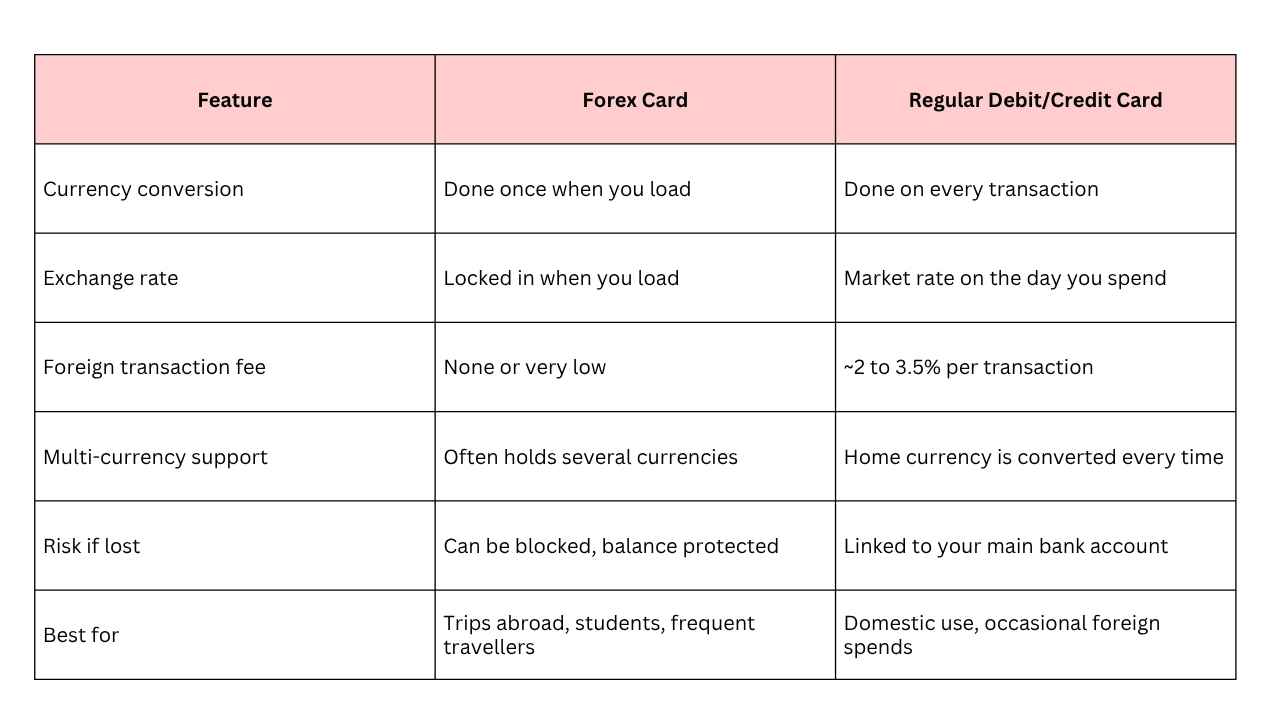
This makes it different from your regular debit or credit card, which converts currency at the time of each purchase and often adds a markup fee.
How Is a Forex Card Different From a Debit or Credit Card?
Why Should You Use a Forex Card While Traveling?
A forex card solves a few common travel problems at once.
- Rate protection: A Forex card lets you lock in the exchange rate on the day you load it. This makes sure you are not affected by future market swings.
- Lower fees: Most Forex cards charge negligible or no foreign transaction markup compared to regular cards.
- Safer than cash: It’s hard to carry cash everywhere you go. A card is convenient to take around. Moreover, a lost or stolen card can be blocked. That’s not the case with cash.
- Widely accepted: Forex cards run on Visa, Mastercard, or RuPay networks, which makes them usable across global merchants and ATMs.
- Easy reloads: You can reload the card with money from anywhere without having to visit a bank.
- Better spend tracking: Most card issuers give you an app where you can check the balance and transactions in real time.
How to Apply and Use a Forex Card?
Using one is simple once you understand the steps.
- Apply for a card: Choose a bank or forex company and pick the currencies you need. The currencies should be those of the country or countries you are planning to visit.
- Submit documents for the card: This usually includes your passport, visa or travel ticket, and PAN card.
- Load the card: Load the card with Indian rupees, and the issuer will convert it into the equivalent amount of the selected foreign currency.
- Use it abroad: Once loaded, you can swipe for purchases, pay online, or withdraw cash from ATMs while you are in another country.
- Reload remotely: You can reload the card with money using netbanking or the issuer’s app.
- Encash unused balance: After the trip, convert any leftover foreign currency back to rupees, or save it for your next trip if the same currency applies.
What Should You Check Before Choosing a Forex Card?
Every issuer has a different set of rules and limitations for the Forex card they offer. It is therefore important to keep a check on what a particular Forex card offers. Here’s a list of things you can check.
- Currencies supported: Check how many currencies a Forex card supports to ensure it works well if you’re visiting more than one country.
- Issuance and reload fees: These fees vary by bank and can add up on longer trips.
- ATM withdrawal fees: You may often need to withdraw cash while in another country. International ATM use often comes with a flat fee per transaction.
- Cross-currency charges: Some banks may charge you extra if you spend in a currency that’s different than what you loaded.
- Customer support: You don’t want to get stuck in a foreign land with no one to help. 24/7 support will ensure you’ll get help with anything related to the card irrespective of the time zone you are in.
- Card network: You’ll want to pick a card network that is accepted well in most parts of the world. Visa and Mastercard are better choices.
What Are the RBI Rules for Forex Cards that You Should Know?
Forex cards fall under India’s foreign exchange regulations, and there are a few rules that affect the way you should be using them.
- Forex card spending falls under the RBI’s Liberalised Remittance Scheme. This scheme sets a yearly limit for travel, education, and other approved purposes.
- Fees on forex prepaid cards must be paid in Indian rupees, as per RBI rules.
- TCS may apply once your yearly forex spending crosses a set limit. So it helps to track your spending through the year.
- Only RBI-authorised banks and licensed money changers can issue forex cards. Check the issuer’s credentials before applying.
Rules around limits and tax rates change from time to time. Always check the latest figures with your bank or the RBI before your trip.
Common Mistakes Travellers Make With Forex Cards
While Forex cards work great on their own, a few mistakes can affect your experience with them. Here are a few things you can avoid to make sure you make the best out of a forex card.
- Loading too little money: Make sure you have an estimated expenditure sorted so you can load your card with the required amount. Frequent reloads later give rise to additional costs.
- Not checking cross-currency charges: Very often, people load their cards with USD even when they are traveling to another country. The very fact that the conversion of currency from USD to the one you are using also costs extra is not considered at first. Make sure you load your card with the right currency.
- Forgetting to activate the card or set a PIN: This is the most crucial step, or rather the first one that you need to do as soon as you receive the card. If not done, you won’t be able to use it in another country after you land.
- Ignoring expiry date: Like all other cards, a Forex card too has an expiry date. You don’t want your card to expire while you are in between trips. So, make sure you know when your card is about to expire.
- Not keeping a backup payment method: Even with the best of preps, there are chances of things going wrong.
Frequently Asked Questions: Forex Cards Explained
Is a forex card better than carrying cash?
Yes, in many cases. A forex card is safer since you can block the card if it’s lost or stolen. Moreover, you’ll see more transparency in the conversion cost rather than the cash exchange counters.
Can I use a forex card at ATMs abroad?
Yes. Most of the Forex cards allow cash withdrawals at ATMs abroad with a flat transaction fee per withdrawal.
What happens to unused balance after my trip?
Forex cards allow you to encash the leftover to the issuer bank or keep it loaded for another trip to the same currency zone.
Do I need a bank account to get a Forex card?
Sometimes. Many licensed Forex companies give you cards without the requirement of a bank account with them.
How many currencies can a Forex card hold?
This depends on the card issuer. Some cards support a single currency, while multi-currency cards can hold ten or more currencies, useful for multi-country trips.